Japheth Wood

the math wizard

Month: April 2011

  • Math Circles and Safety

    The Bard Math Circle is growing rapidly this year. Perhaps this started because the wonderful Kingston Library director, Margie Menard, sent out a press release that was picked up by the local media, or that we’ve worked hard to develop a consistent and predictable schedule. But the fact is that the Bard Math Circle has found its niche: libraries.

    This has me thinking of ways to ensure that our activities are safe spaces.

    Safe to Take Risks
    One important aspect of this is that participants should feel safe to take mathematical risks. Considering all the adults I meet whom have experienced some sort of mathematical trauma when they were young, this is crucial. Participants need to feel safe to explore mathematical ideas.

    Here’s a quote from a Kingston grandmother who brought her granddaughter to yesterday’s math circle. After hearing this, I know that we’re doing a great job:

    Since she’s been coming here, her math has improved. She thinks about things now. This is the most worthwhile thing she’s been involved in.

    Right on! We’re definitely going to come back to this topic in the future.

    Physical Safety
    Another important aspect of safety for our Math Circles is physical safety. I traveled to Houston last month to attend the Circle on the Road Spring 2011 conference. Besides some incredible mathematics, the most interesting presentation, by far, was Brandy Wiegers‘ talk, Always Be Prepared. Brandy has been involved in Girl Scouting for over 20 years, and as a result, she is the mathematician I’d most want to be with in an emergency.

    Here’s Brandy’s abstract:

    Math Circles should be fun and engaging. To keep it this way it is important to be prepared with a box of tricks and some quick plans to ensure safety. In this session we’ll discuss what we keep in our Math Circle Box of Supplies, important legal aspects of working with minors including adult to student ratios and the buddy system. We’ll conclude the session discussing participant waivers and plans for emergencies. With a little bit of work we can all be more prepared to ensure that we never need to use our emergency plan. This way we can get back to math and everyone can have fun!

    Brandy’s talk was really a Math Circle milestone. Talking about safety means that Math Circles are established, and that it’s now time to plan for safety. What procedures and guidelines does your Math Circle have in place to ensure the physical safety of your students? I think this is the beginning of a Math Circle discussion at the national level.

    Well, Brandy did give us a lot of useful information. Perhaps the best thing she did was point us to the Girl Scouts, who’ve put a whole lot of thought into how to keep girls safe.

    Safety-Wise
    The decades-old Girl Scout safety bible is a publication known as Safety-wise. I just found out that this publication has been replaced with the new publications:

    • Volunteer Essentials
    • Safety Activity Checkpoints
    • Risk Management

    Here are links to some specific online Girl Scout safety pages:

    These safety guidelines are focused on keeping girls safe, but one thing I know for sure – if it’s good enough to keep the girl scouts safe, then it will keep all of our math circle students safe!

    Now, let’s get back to math and have fun!

  • Jim and Nim

    I presented my talk “Jim and Nim” yesterday at the Bard Math Seminar, and managed to fill the house.


    My introduction actually extended over two days, as I visited math and CS classes on Wednesday and Thursday and personally invited students to my talk. This was really fun, and I got to meet some of Bard’s amazing undergraduates. I teased them with the Magic Birthday Trick:

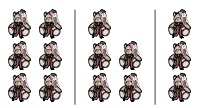
    Have you seen this?

    1. Identify the boxes that contain the day of the month that you were born. (For example, I was born on the 18th, and the number 18 appears only in the two boxes on the right.)
    2. Add up the numbers in the top left of each box that includes your birthdate. (For me, that’s 2 + 16.)
    3. The sum is mathemagically your birthdate.
    4. Share in the amazement!

    Here’s a picture that I used to explain why this trick works. I’ll leave it to you to puzzle it out!

    Another teaser I shared is the game I call 21-Nim. Start with 21, and on your turn you subtract 1, 2 or 3. The first person to reach 0 is the winner.  (My MAT student Kristen used this at our Pi Day Celebration for the students at 345 Brook Avenue in the Bronx.) What’s interesting here is the set of losing numbers, and I challenged the Bard students to find them. In a losing position, the next player will lose, if her opponent plays correctly. Can you find the losing positions?

    We didn’t play 21-Nim during my talk, but we did play the classic game of Nim, with Teddy Bears:

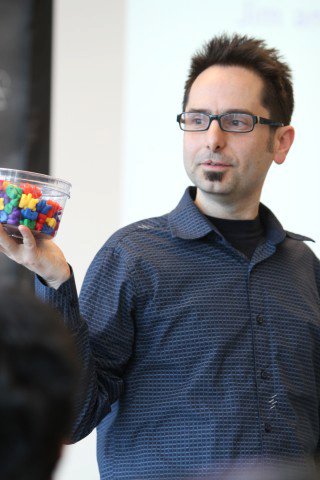
    Here’s a picture of me, getting ready to hand out the teddy bears.
    (This amazing photo is by Rusty, who was visiting Bard with his son Kyle the day of my talk.)

    The Game of Nim
    This is the real game of Nim, whose winning strategy was first described and proved in a math research paper published in 1901. The game starts with several piles of counters. Players alternate moves: on your turn, select a pile and remove at least one counter from that pile. You win if you take the last counter from the last pile. That is, the last player with a legal move wins. If you know the set of losing positions, then you know the winning strategy! 


    Strategy
    I had the participants play a few games of Nim, just to get the feel of the game and to start identifying the losing and winning positions. The amazing thing about impartial combinatorial games is that in each game position (with a finiteness condition) there must either be a winning strategy for you, or your opponent has a winning strategy. I call these two possibilities Winning and Losing positions (the standard notation from Winning Ways is N and P positions), which brings up a natural opportunity to use quantifiers:
    • If you are in a Losing position, then EVERY move you make leads to a Winning position for your opponent.
    • If you are in a Winning position, then there EXISTS a move that leaves your opponent in a Losing position.
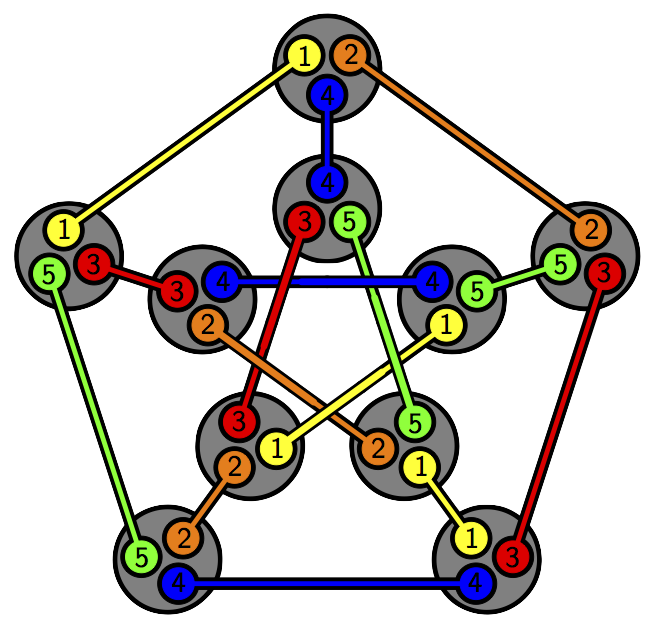
    I represented this in the following diagram:


    Jim
    Did I mention that I invented a Nim-type game that I call “Japheth’s Nim”, or Jim for short? One day in February 2011, I was running around Prospect Park in Brooklyn and thinking about how to motivate the strategy for Nim. Halfway around the park, I realized that a visual representation of the binary number strategy could be described independently of its connection to binary numbers and exclusive OR. I used the rest of my run to figure out just how to describe a Nim move visually in binary, which resulted in the game of Jim.
    A Jim game starts with  several rows of red and yellow tokensPlayers alternate moves: select a row, and change one or more tokens (yellow to red or red to yellow). The first token to be changed (from the left) must be yellow (but does not need to be the leftmost yellow token). The last player with a legal move wins. Equivalently, if you only see red tokens, then you’ve just lost! 
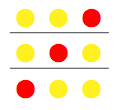
    Here’s a 3-row Jim game:

    Can you explain why this is a Losing position?
    One of the most exciting parts of the talk was at the end, when I revealed the connection between Jim and Nim with this slide:

    Well, you might have had to be at my talk for this to make sense. Please leave a comment below to describe how Nim and Jim are related!

  • Hungarian Dancing and Sorting Algorithms

    My brother and later a colleague sent me this link to these videos demonstrating Computer Sorting Algorithms through Hungarian Folk Dance:


    The Bubble Sort and Shell Sort algorithms are demonstrated. Wow!


    Credits from the video: 

    Created at Sapientia University, Tirgu Mures (Marosvásárhely), Romania.Directed by Kátai Zoltán and Tóth László. In cooperation with “Maros Művészegyüttes”, Tirgu Mures (Marosvásárhely), Romania.Choreographer: Füzesi Albert. Video: Lőrinc Lajos, Körmöcki Zoltán. Supported by “Szülőföld Alap”, MITIS (NGO) and evoline company.


    So, this is actually a Transylvanian video.

    I first learned the algorithms in high school from the Art of Computer Programming, ancient tomes written by Donald Knuth, and also in my AP Computer Science class, the first year it was offered. We wrote our code on paper, and eventually implemented the programs in Pascal on state-of-the-art Apple ][‘s, once the teacher figured out how to load it on the computers!

  • Fiber Arts and Mathematics

    Crafting by Concepts: Fiber Arts and MathematicsWow! This book claims to show 8 ways to knit a Sierpinski’s Triangle!
    Crafting by Concepts: Fiber Arts and Mathematics
    by sarah-marie belcastro and Carolyn Yackel (editors).
    The publisher, A K Peters , has one of the most amazing math catalogs that I know of. Very much worth browsing!